

There has been discussion about Prime Minister Andy Burnham’s recent EU trade and youth mobility deal. This deal would mean 100,000 young Britons, aged 18 to 31, would be allowed to live, work, study, and travel in the EU, with reciprocal access for Europeans in the UK. Much discussion on social media has focused on EU students from within the European Economic Area (EEA), who, under this deal, would potentially pay the UK home student tuition fee of £9,970 (€11,884.24 or $13,100 USD), instead of the higher tuition fees paid by non-EU/EEA migrant students. While the UK and the EU continue to negotiate what the tuition fee structure will be for prospective EEA university students, URBC wants to outline the commentary around EEA students and the two elephants in the room that continue to elude the spotlight.
Predictably, commentators from the Right, Centre, and Left have chimed in with their thoughts that have revealed more about their lazy xenophobic assumptions.
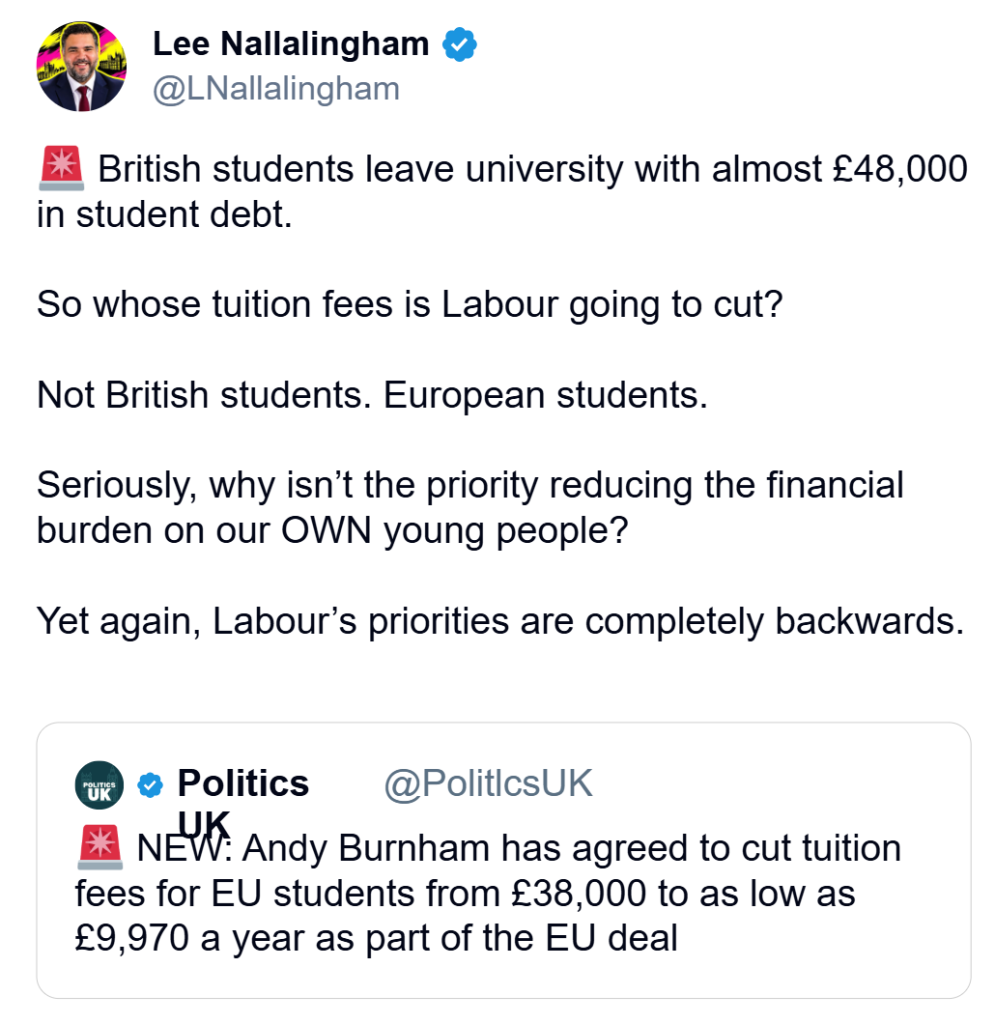
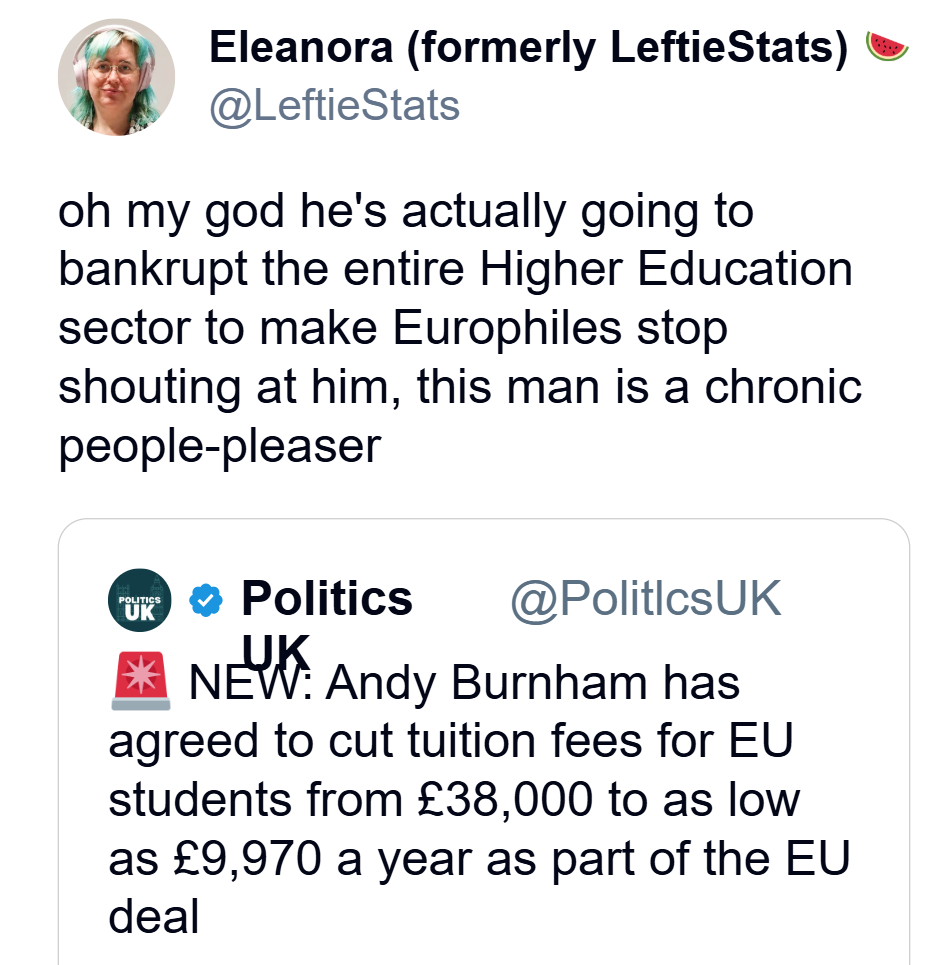
Before Brexit and the end of EEA free movement on 31 December 2020, in the UK, EEA students paid tuition fees like domestic UK students. Brexit changed that, and EEA students were now treated similarly to international students (migrant students) from outside the EEA and subject to the Hostile Environment immigration policy. This meant EEA students who arrived after the end of free movement had to apply for student visas, pay the International Health Surcharge to access the NHS, have no recourse to public funds, and be required to pay the international student tuition fee. Depending on the course of study, international tuition fees can be anywhere from £11,400–£38,000+ per year.
The Brexit effect caused a significant drop in EEA student enrolment in UK higher education. In June 2025, The Migration Observatory at the University of Oxford reported that EEA student enrolment in UK higher education declined by 57% between 2020/21 and 2023/24, with a significant drop in Romanian and Polish student enrolment. The high expense of UK higher education, followed by immigration precarity, and stories of EEA citizens who had been long-term British residents being rejected for settled status meant fewer EEA citizens felt that the UK was a safe place to study and contemplate long-term residency.
Likewise, there has been a steady decline in non-EEA student enrolment in UK higher education. Increases to the student visa and International Health Surcharge fees, which can run into the thousands if bringing dependents, followed by a more stringent immigration process for students from non-EEA countries, coupled with the global cost-of-living problem and growing inflation, fascist pogroms and violent hostility towards migrants, immigration raids that have found migrant students in immigration detention, and the criminalisation of Palestine solidarity on campus, have undoubtedly contributed to a 10% decline in non-EEA student numbers.
Declining international student enrolment has also been felt outside the UK, in the US and Canada. Like the UK, the US and Canadian immigration systems have adopted stricter policies for international students. In the US, ICE detention of both international scholars and students has become a regular occurrence, especially since the Trump administration attacked migrant students involved in Palestine solidarity activism, best exemplified in our solidarity with Amandla Thomas-Johnson and Momodou Taal with the Boycott Cornell campaign.
Even with the growing decline in the collective number of both EEA and non-EEA migrant students in UK higher education, Times Higher Education whipped up xenophobia by claiming in April 2025 that migrant students were squeezing out UK domestic students for university places. Meanwhile, UK universities are experiencing massive academic redundancies and departmental closures, often blamed on the declining numbers of migrant student enrolment.
This brings us to the first elephant in the room that consistently gets deliberately ignored: if EEA student tuition fees are lowered to the UK rate, it will be non-EEA students, NOT UK students, who will shoulder this expense, much like their tuition fees have been used to subsidise the tuition fees of UK domestic students.
When the UK had “free education” until 1998, it was made possible because of the introduction of tuition fees for students from Commonwealth countries. As Raji and Schwoerer argue in The Sociological Review, “Higher education and nation-building after Empire: Migrant students in post-war Britain” (2025), international student fee policies in British higher education functioned as a tool of bordering, racialisation, and capital accumulation following the end of the British Empire. Raji and Schwoerer write,
“Between 1962 and 1967, growing right-wing activism led the Conservative Party to make immigration controls central to their platform; immigration was restricted further with the 1968 Commonwealth Immigrant and 1971 Immigration Acts (El-Enany, 2020). Aiming to decrease public spending, the 1967 policy introducing differential fees for ‘overseas students’ created two categories of students, as well as paving the way towards marketisation some decades in the future.”
Cementing the chasm of differential tuition fees between EEA and Commonwealth students began when the UK entered the EEA in 1973. In 1979-1980, there were increases to visa fees and tuition fees for non-EEA students from Commonwealth countries who were told that they would now be required to pay the entire cost of their education and would no longer receive public subsidies. As Raji and Schwoerer argue,
“The decision to charge full fees to Commonwealth students while positioning EEC students as ‘home students’ can be understood as part of the reorientation of Britain away from its colonies and towards the EEC; a way of, in El-Enany’s (2020) words, further separating the spoils of Empire off from its producers.
It is fascinating that over a decade of student-led activism around decolonising the university, no one questions the very colonial origins of free education, and who historically was granted free education. There is little acknowledgment that UK higher education survives off of the Global South, whose students’ tuition fees subsidise the lower tuition fees British home students pay. Meanwhile, students from non-EEA countries, especially those in the Global South, are forced to pay exorbitant tuition fees while subjected to intense border policing as a result of the Hostile Environment policy.
Just like the 1970s, we are once again witnessing Britain’s reorientation back to the EU. And this brings us to the second elephant in the room: Burnham’s overtures to the EU have everything to do with the EU’s recent deal to send failed asylum seekers to Rwanda. Starting in 2027, five EU countries- Denmark, Austria, Germany, the Netherlands, and Greece will be sending failed asylum-seeker men to Rwanda. While the UK’s Rwanda plan was rescinded in 2024 under Starmer’s leadership, this has not dissuaded our current Labour government from exploring outsourced immigration detention in European countries outside of the EEA, like Kosovo and North Macedonia.
To conclude, British and EEA students, whether studying in the EU or the UK, are being used as pawns to enact more draconian borders on asylum seekers, in addition to non-EEA migrant students, whose tuition fees will subsidise the university education of British and EEA students. Meanwhile, with greater cooperation, the UK and the EU will use their renewed relationships to enact more violent and harmful border policies designed to keep out the Global South. If you are fundamentally more invested in “saving UK universities” but have zero understanding of how UK universities fuel border violence and the Hostile Environment policy, what exactly are you saving?