
Mohammed from Education Without Chains Explains How Financial Barriers in Gaza Because of Ongoing Genocide & Scholasticide Affect the Ability of University Students to Graduate
Mohammed Abuiwaili, the co-founder of Education Without Chains and a recent graduate with a Bachelor’s in Medical Laboratory Sciences from Al-Azhar University Gaza, describes in this clip the insurmountable financial barriers caused by ongoing genocide. This financial barrier before October 2023 made it difficult to be able to pay tuition fees and complete university education. Now, as genocide continues, many more Gaza university students are stuck in limbo, having no ability to either pay outstanding tuition fees to be able to graduate or continue and finish their degree courses.
About Education Without Chains
The Education Without Chains survey came about in August 2025. Mohammed Abuiwaili, a recent graduate of Al-Azhar University in Medical Laboratory Sciences, was connected through UK student activists to Sanaz Raji, a migrant campaigner and academic researcher in England. Initially, the student activists led Sanaz to believe that Mohammed was having an immigration problem coming to the UK. However, upon speaking to Mohammed directly, Sanaz realised that the problem was not related to immigration, but rather educational barriers because of scholasticide and ongoing genocide in Gaza, creating insurmountable difficulties in paying tuition fees. Mohammed connected Sanaz with Shaker Albuhaisi, another graduate of Al-Azhar University, who also had outstanding tuition fees that needed to be paid to receive his graduate certificate.
As migrant academic scholars and students, Unis Resist Border Controls (URBC) viewed the educational exclusion that both Mohammed and Shaker were experiencing because of genocide as something similar to the exclusion that migrant students also experience because of state violence as a result of the Hostile Environment Policy, draconian border regimes and financial precarity caused by the rapidly more stringent immigration laws. URBC made a collective decision to use some funds intended for legal casework for migrant students in need of urgent support to pay for the outstanding tuition fees owed by both Mohammed (£744.33) and Shaker (£297.73). Clearing these outstanding tuition fees helped Mohammed and Shaker receive their certification of graduation. This, in turn, allowed Shaker to commence a scholarship with Scholarships for Ghazza to study at University College Dublin in Ireland. URBC also supported Shaker with a laptop and some additional funds for living costs for both Mohammed and Shaker.
In semi-regular Zoom meetings with URBC, both Mohammed and Shaker underscored the financial difficulties of university students in Gaza. Through these discussions, Sanaz indicated that establishing a survey to understand the true extent of funding problems caused by scholasticide and the ongoing genocide was vital in helping others outside of Gaza understand the problem and work to support students affected and help rebuild Gaza’s higher education system. Thus, Education Without Chains, a campaign within URBC, was born. Working collaboratively, Mohammed, Sanaz, and Shaker launched the Education Without Chains Survey online to university students in Gaza on 6 October 2025. Mohammed and Shaker helped circulate the study through university contacts via word of mouth and through university Gaza student WhatsApp groups. The survey ran for 2 months and 25 days, concluding on 31 December 2025, and received 627 responses. Later this month, the study’s findings will be published with recommendations.
URBC at BRISMES Annual Conference. Introducing Education Without Chains: A Campaign for Dignity within Gaza’s Higher Education System
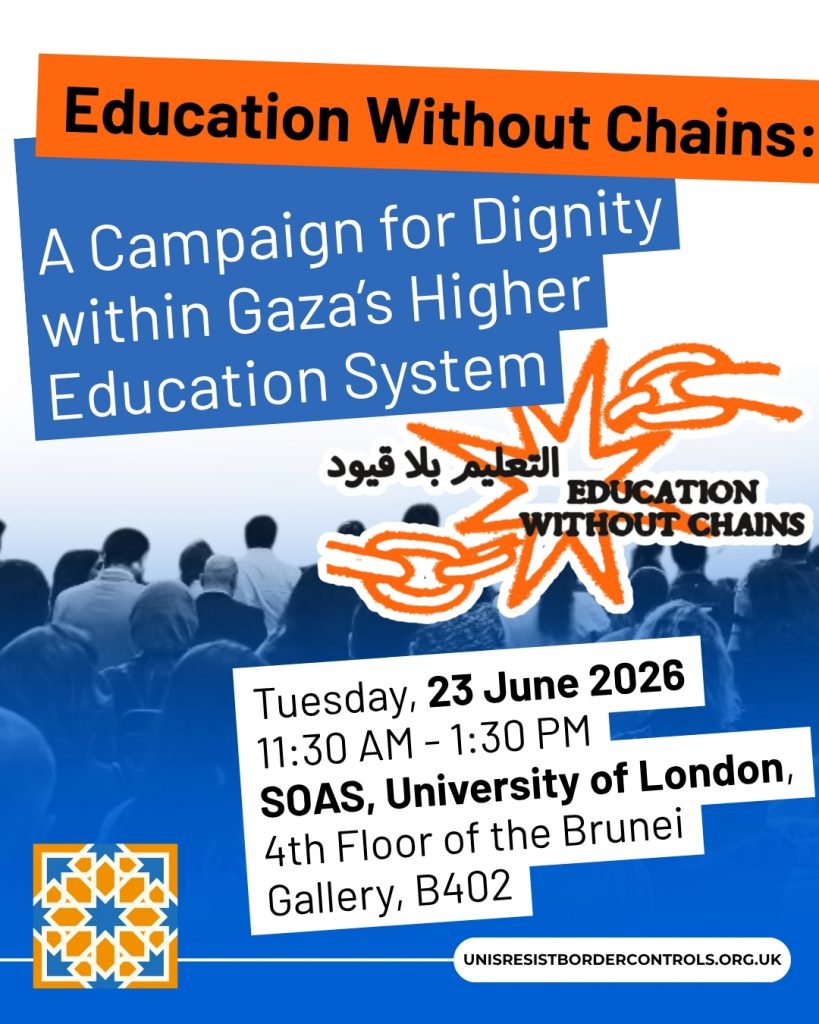
From October 2025 to December 2025, working with two Al-Azhar University graduates from Gaza, URBC conducted a survey to understand the effects of financial barriers that contribute to educational exclusion on university students in Gaza, before and after 7 October 2023. This exclusion is a symptom of ongoing genocide that is either preventing university students in Gaza from matriculating in their degree programmes or from graduating because of outstanding tuition fees owed.
Gaza’s higher education system relies heavily on students’ tuition fees to pay lecturers and to help rebuild its infrastructure, which has been damaged by scholasticide. Our roundtable will discuss findings from our survey conducted inside Gaza and an urge for academics, students, and activists to redirect their attention to supporting the stabilisation of Gaza’s higher education system and society by ensuring that these outstanding tuition fees are paid.
As migrant students and academics who face educational barriers and border violence because of the Hostile Environment Policy, we conducted this work with our Gaza colleagues to underscore the importance of connecting shared experiences and working to ensure the liberation of Palestine.
Sanaz Raji from URBC will chair a roundtable talk that will be joined by three students in Gaza: Heba Shaaban Sulaima Qudaih (Nurse Graduate), Mohammed Abuiwaili (Graduate from Al-Azhar University), Shaymaa Abu Azzoum (3rd Year Medical Student, Al-Azhar University ), along with Shaker Albuhaisi (University College Dublin).
Student and unwaged tickets for day attendance at the BRISMES conference can be found here. If you are having problems with the BRISMES day rate, send URBC an email, and we will help facilitate your attendance at our roundtable.
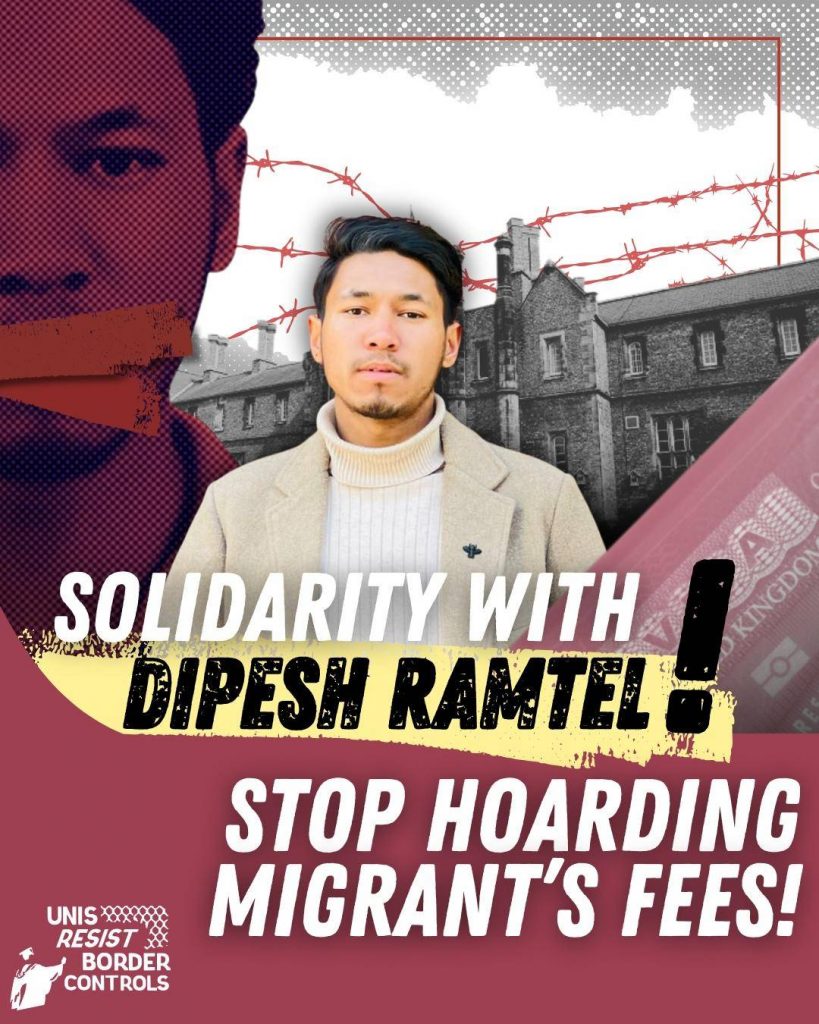
Solidarity Statement with Dipesh Ramtel #StopHoardingFees #SolidarityWithDipesh DEADLINE TO SIGN BY: 11PM, FRIDAY 30 JANUARY 2026
Addressed to
Professor Karen Bryan, Vice Chancellor, York St John University
Dr Rob Hickey, Chief Operating Officer, York St John University
Professor Richard Bourne, Pro Vice Chancellor Education, York St John University
Professor Robert Mortimer, Pro Vice Chancellor: Research and International, York St John University
Background
Dipesh Ramtel is a migrant undergraduate student from Nepal who was studying Business Administration at York St John University. He was detained on an immigration raid in October at the restaurant where he was working part-time. Dipesh had mistakenly worked a little over the 20-hour limit allowed for student visa holders. Since May, Dipesh’s father has not been able to send the monthly £400 intended for his maintenance. With a significant dip in his finances, Dipesh supported himself through part-time restaurant work. Migrant students from low-income countries, like Nepal, with a GDP per capita of $1,447.31 USD, experience the UK’s cost-of-living crisis more violently. Under the Immigration and Asylum Act 1999, student visa holders like Dipesh are excluded from benefits and housing. This means that migrant students like Dipesh have no safety net should they face financial problems while living in the UK.
After Dipesh was detained, he spent three days in prison before being transferred to Harmondsworth Immigration Removal Centre (IRC), the largest immigration detention centre in all of Europe. After informing his family of his detention, Dipesh’s family encouraged him to return home. Dipesh informed the detention personnel and York St John University of his decision to return to Nepal. The head of immigration compliance at York St John University sent Dipesh an email while in detention, indicating that he had been withdrawn from his course following detention. The email also indicated that Dipesh could request a refund of his autumn semester’s tuition fees, stating,
“I have also attached a refund form for your completion and return, should you wish to request a refund. Your request will be assessed and you will be informed by our Finance Team @student-transactions, if you are due for any refund.”
Dipesh was removed from the UK on 17 November. On 21 November, Dipesh was sent an email by York St John University’s International Development Manager stating that the university would no longer refund his autumn semester tuition fees, totalling £5,750:
“The denial is based on a confirmed breach of your Student Visa conditions. Our records show you worked beyond the permissible 20 hours per week limit, a mandatory and non-negotiable requirement of your visa. Compliance with the working hour restrictions is essential for maintaining enrolment status and eligibility for any institutional refund.”
Dipesh is being double-punished- both by the UK’s carceral immigration policy and by York St John University, who are keeping the tuition fees that could help support him and his family.
Dipesh in his own words
“I was shocked and frustrated when I learn that York St John University is now refusing to refund my tuition fees for the autumn term. I trusted the university when they told me earlier that the fees would be refunded if I couldn’t continue my studies because of the situation. Now it feels that they’ve broken that promise and are avoiding me whenever I try to contact them.
Without that refund, my family and I are facing serious financial problems. We used a huge amount of our savings to pay those fees, and now that I am back in Nepal, I need that money to continue my education in my country. Without it, I may not be able to study at all. The university’s decision is stopping me from moving forward with my life, and it’s putting a lot of pressure on my family, who are already struggling after everything that happened.
Extractivism by York St John University in Nepal
York St John University, formerly the College of Ripon and York St John, became a university in 2006 and expanded to awarding doctoral degrees in 2015. The creation of York St John University in the 2000s was when Labour under the Blair and later Brown governments saw the establishment of thousands of full-time and part-time university places. With the introduction of tuition fees for Home students, Labour also sought to increase migrant student numbers because they pay higher tuition fees that subsidise Home student tuition fees and help to fund marketised UK higher education. However, the UK university market-driven policy created an extractivist education model that they practice along with the Hostile Environment policy, the Prevent Duty, genocide, war, and ecological violence, which reproduces colonialism, carcerality, and capitalistic violence. The continual mistreatment of migrant students like Dipesh is a canary in a coal mine, warning of the continued violence that market-driven higher education has produced.
Nepal has figured prominently as part of York St John University’s internationalising agenda in acquiring new markets of migrant students to fill management’s coffers. Lei Wang, International Development Manager for York St John University, wrote on his LinkedIn profile in the aftermath of Nepal’s Gen Z protests in September,
“We recognise the resilience and strength of the Nepalese community, and we stand alongside you. To our current and prospective students: please know that your safety and wellbeing are our highest priority. We also deeply value the trust and commitment of your families and friends who support you on your educational journey.
York St. John University remains committed to nurturing our strong and growing partnership with Nepal, and to ensuring that students have the support they need—whether here in the UK or in their home country.”
The post was endorsed by Sunil Tuladhar, Country Coordinator for Nepal – York St. John University, along with Dibya Maharjan, Manager at Real Dreams Consultancy. Real Dreams Consultancy is an educational agency in Nepal that guides prospective students on their application and visa process for studying in the UK. On their website, Real Dreams Consultancy explains that York St John University is “The cheapest UK university for Nepalese students.” One must ask why York St John University’s recruitment presents intentionally misleading marketing of studying at York St John University that neglects to mention UK’s cost-of-living crisis, while factoring in the economic violence inside Nepal, in addition to more stringent UK border controls for Nepalese youth who are dealing with the tremors of political upheaval, coupled with a high unemployment rate. How does York St John University’s treatment of Dipesh Ramtel support their commitment to “ensuring that [Nepalese] students have the support they need- whether here or in the UK or in their home country?”
Dipesh’s case underscores the continued colonality of UK universities that treat migrant students as expendable for their tuition fees while subjecting them to border violence.
Demands
We, the undersigned, demand that York St John University:
1. Immediately refund Dipesh Ramtel his autumn 2025 term tuition fee, totalling £5,750.
2. To make a public apology for contributing to worsening mental and physical health by attempting to steal and financially disadvantage Dipesh and his family in the most vile manner, as they recover from his immigration detention and his family losing their savings that were used to pay tuition fees to York St John University.
3. To stop hoarding the tuition fees of migrant students who find themselves in immigration detention for merely trying to survive economic exploitation at the hands of your university and border violence.
4. Stop misleading and harmful advertisements to migrant students, particularly from low-income countries, that do not reflect the situation on the ground in relation to the UK’s inflation rate, the Hostile Environment policy, and the changing landscape of immigration.
5. To end punitive border controls on campus via the Hostile Environment policy.
DEADLINE TO SIGN BY: 11PM, FRIDAY 30 JANUARY 2026
List of signatories will be updated every Wednesday.
Click to sign the letter here.
Expansion of UK’s carceral borders in the Western Balkans // Zgjerimi i kufijve kufitar të Mbretërisë së Bashkuar në Ballkanin Perëndimor
On 21 October, it was reported that Kosovo has offered to become the first Western Balkan country to accept refugees who have been refused asylum as part of the UK government’s plan to create return hubs in a third country. Albin Kurti, Prime Minister of Kosovo, indicated that in return for accepting the UK’s refused asylum seekers, he seeks from the UK government “support in security – be that through strategic agreements or through equipment and projects we might do.” Between 1998-1999, Kosovo Albanians were subjected to ethnic cleansing by Serbs during the breakup of Yugoslavia. The US and UK provided covert military assistance to the Kosovo Liberation Army in the lead-up to the 1999 NATO bombing campaigns. Unsurprisingly, before declaring independence from Serbia in 2008, Kosovo began to position itself as a bastion of Euro-Atlantic security interests in the Western Balkans during the early War on Terror years. While such geopolitical alignments with Euro-Atlantic policies may appear at first sight as a matter of political choice, they should be understood within the complex context of Kosovo’s precarious status in the international arena: one that compels the country to align with the United States and the European Union, upon which it remains heavily reliant for its security and international legitimacy.
In 2005, it was reported in Der Spiegel that Kosovo allowed for a CIA black site prison inside the U.S. Army base, Camp Bondsteel, where detained men were held for months without a trial in deplorable conditions similar to those found at the infamous Guantanamo Bay detention camp. Another aspect of Kosovo’s strengthening ties with the Euro-Atlantic security order can be seen in its close relations with Israel, brokered by the US in 2021, when Kosovo opened an embassy in Jerusalem. Both Kosovo and Israel have cooperated in counter-terrorism work, which includes Israel providing training to Kosovo law enforcement.
Earlier this year, Kosovo signed an agreement with Denmark to send 300 non-European national prisoners to serve the rest of their sentences at Gjilan prison. In exchange for accepting non-European prisoners, the Danish government will give Kosovo a yearly amount of €15 million, with €5 million used to bring Gjilan prison up to Danish standards. We must bring up Kosovo’s history interlinked with the Euro-Atlantic security order, because the Kosovo government is actively encouraging the expansion of the prison and border regime inside its country in exchange for money, security, and arms, all of which will be used to harm migrants, along with their own citizens. As Piro Rexhepi reminds us in White Enclosures: Racial Capitalism and Coloniality along the Balkan Route (2023), the coloniality of EU relations in the Western Balkans, where EU integration, economic, and security partnerships are conditional, provided that countries along the Balkan immigration route become the dumping ground for Europe’s, and now the UK’s, migrant problem.
The UK’s failed Rwanda Plan of two years ago has not dissuaded politicians from either side of the parliament from finding another pathway towards outsourcing its violent borders. Instead of de-escalating the anti-migrant, anti-Muslim pogrom in August 2024 that began in Southport and later engulfed the entire UK, Prime Minister Keir Starmer is actively both inflaming and normalising anti-migrant rhetoric. This was seen in May, when Starmer said the UK is “becoming an island of strangers,” paraphrasing similar rhetoric from another infamous racist-xenophobic British politician, Enoch Powell. The summer of 2025 has been equally vicious for UK asylum seeker and migrant communities, with an anti-migrant, anti-Roma pogrom that happened in June in Ballymena, Northern Ireland, followed by a series of anti-migrant protests at the Bell Hotel in Epping and other sites in England.
Starmer’s policies are contributing to the growing far-right rhetoric against migrants, while also fascist Reform Party is dominating polls, emboldening and normalising fascism in the UK. Meanwhile, as the right-wing British media parade the view that asylum seekers have nefarious, criminal, and sexually deviant intentions while in the UK- views that are driving normalised xeno-racism, there is little outcry that 50 lone child asylum seekers have vanished while in state care. A significant number of asylum seeker children who have disappeared while in care are Albanian. The border violence via the UK’s 13-year Hostile Environment policy against migrants affects all racialised populations and also particularly Albanians and Kosovans, who, either as asylum seekers or undocumented, find themselves routinely detained and deported in secret deportation flights without the ability to contest their deportation.
As abolitionists working to dismantle carceral borders and the colonial dynamics that underpin such systems of oppression, we recognise that the struggle to end outsourced detention in Kosovo and the extension of UK borders starts with cooperation between Kosovo and UK activists, and beyond. A transnational, united, and focused campaign to stop outsourced detention in Kosovo is what we, the undersigned, will endeavour to establish to stop the UK and the EU from treating in a typically colonial manner developing regions of Europe. We seek to affirm migrant liberation and stop the genocidal policies against migrants, which, in turn, forces them to make more precarious and deadly decisions as a result of the growing carceral border policies enacted.
Translation in Albanian
Më 21 tetor, u raportua në media se Kosova ka pranuar të bëhet vendi i parë i Ballkanit Perëndimor që pranon refugjatë të cilëve iu është refuzuar azili, si pjesë e planit të qeverisë së Mbretërisë së Bashkuar për të krijuar qendra rikthimi në një vend të tretë. Albin Kurti, Kryeministri i Kosovës, tregoi se në këmbim të pranimit të azilkërkuesve të refuzuar të Mbretërisë së Bashkuar, ai kërkon nga qeveria e Mbretërisë së Bashkuar “mbështetje në siguri – qoftë përmes marrëveshjeve strategjike apo përmes pajisjeve dhe projekteve që mund të bëjmë”. Midis viteve 1998-1999, shqiptarët e Kosovës iu nënshtruan spastrimit etnik nga regjimi serb gjatë shpërbërjes së Jugosllavisë. SHBA-të dhe Mbretëria e Bashkuar ofruan ndihmë të fshehtë ushtarake për Ushtrinë Çlirimtare të Kosovës në prag të fushatave të bombardimeve të NATO-s në vitin 1999. Siç pritej, para se të shpallte pavarësinë nga Serbia në vitin 2008, Kosova nisi të pozicionohej si një bastion i interesave të sigurisë euroatlantike në Ballkanin Perëndimor gjatë viteve të hershme të Luftës kundër Terrorizmit. Ndërsa rreshtime të tilla gjeopolitike me klubin euroatlantik mund të duken në pamje të parë si një zgjedhje politike, ato duhet të kuptohen brenda kontekstit kompleks të statusit të pasigurt të Kosovës në arenën ndërkombëtare: një kontekst që e shtyn vendin të rreshtohet me Shtetet e Bashkuara dhe Bashkimin Evropian, tek të cilët mbetet shumë i varur për sigurinë dhe legjitimitetin e tij ndërkombëtar.
Në vitin 2005, Der Spiegel publikoi se Kosova lejoi ndërtimin e një burgu të fshehtë të CIA-s brenda bazës së ushtrisë amerikane, Kampi Bon in dsteel, ku burrat e burgosur u mbajtën për muaj të tërë pa gjyq në kushte të mjerueshme të ngjashme me ato në kampin famëkeq të paraburgimit në Gjirin e Guantanamos. Një aspekt tjetër i forcimit të lidhjeve të Kosovës me rendin e sigurisë euroatlantike mund të shihet në marrëdhëniet e saj të ngushta me Izraelin, të ndërmjetësuara nga SHBA-të në vitin 2021, kur Kosova hapi një ambasadë në Jerusalem. Si Kosova ashtu edhe Izraeli kanë bashkëpunuar në “Luftën kundër Terrorizmit”, e cila përfshin ofrimin e trajnimeve nga Izraeli për zbatimin e ligjit në Kosovë.
Në fillim të vitit, Kosova nënshkroi një marrëveshje me Danimarkën për të dërguar 300 të burgosur jo-evropianë për të vuajtur pjesën tjetër të dënimit në burgun e Gjilanit. Në këmbim të pranimit të të burgosurve jo-evropianë, qeveria daneze do t’i japë Kosovës një shumë vjetore prej 15 milionë eurosh, ku 5 milionë euro do të përdoren për të përmirësuar burgun e Gjilanit në pajtim me standardet daneze. Ne duhet ta pozicionojmë historinë e Kosovës si të ndërlidhur me rendin e sigurisë euro-atlantike, sepse qeveria e Kosovës po inkurajon në mënyrë aktive zgjerimin e regjimit të burgjeve dhe kufirit brenda vendit të saj në këmbim të parave, sigurisë dhe armëve, të cilat do të përdoren për të dëmtuar migrantët, së bashku me qytetarët e tyre. Siç na rikujton Piro Rexhepi në White Enclosures: Racial Capitalism and Coloniality Along the Balkan Route (2023), kolonializmi i marrëdhënieve të BE-së në Ballkanin Perëndimor, ku integrimi në BE, partneritetet ekonomike dhe të sigurisë janë të kushtëzuara, me kusht që vendet përgjatë rrugës ballkanike të imigracionit të bëhen vendi i depozitimit për problemin e migrantëve të Evropës dhe tani të Mbretërisë së Bashkuar.
Plani i dështuar i Mbretërisë së Bashkuar me Ruandën dy vite më parë nuk i ka dekurajuar politikanët nga të dyja anët e spektrit politik që të gjejnë një rrugë tjetër drejt zhvendosjes së kufijve të tyre të dhunshëm. Në vend që të ndalojnë pogromin anti-migrant dhe anti-musliman të gushtit 2024 që filloi në Southport dhe më vonë përfshiu të gjithë Mbretërinë e Bashkuar, Kryeministri Keir Starmer po e nxit dhe po e normalizon retorikën anti-migrante. Kjo u pa në maj, kur Starmer tha se Mbretëria e Bashkuar po “bëhet një ishull i të huajve”, duke perifrazuar retorikë të ngjashme nga një tjetër politikan britanik famëkeq dhe racist, Enoch Powell. Vera e vitit 2025 ka qenë po aq e ashpër për komunitetet e azilkërkuesve dhe migrantëve në Mbretërinë e Bashkuar, me një pogrom anti-migrant dhe anti-rom që u zhvillua në qershor në Ballymena, Irlandën e Veriut, e ndjekur nga një seri protestash anti-migrante në Bell Hotel në Epping dhe vende të tjera në Angli.
Politikat e Starmer po ushqejnë retorikën në rritje të ekstremit të djathtë kundër migrantëve, ndërsa Partia Reformiste fashiste po dominon sondazhet, duke inkurajuar dhe normalizuar fashizmin në Mbretërinë e Bashkuar. Ndërkohë, ndërsa media britanike e krahut të djathtë nxit stereotipet se azilkërkuesit kanë qëllime të liga, kriminale dhe seksualisht të devijuara ndërsa janë në Mbretërinë e Bashkuar – pikëpamje që po nxisin kseno-racizëm të normalizuar, ka pak protesta dhe mbulim mediatik për 50 fëmijëtt azil-kërkues e zhdukur nga kujdesi shtetëror. Një numër i konsiderueshëm i fëmijëve azilkërkues që janë zhdukur teksa kanë qenë nën kujdesin e shtetit britanik janë shqiptarë. Dhuna kufitare nëpërmjet politikës 13-vjeçare të Mbretërisë së Bashkuar për një mjedis Armiqësor kundër migrantëve prek të gjitha popullatat e racializuara dhe veçanërisht shqiptarët dhe kosovarët, të cilët, qoftë si azilkërkues apo individë të pa dokumentuar, e gjejnë veten të ndaluar dhe të deportuar rregullisht në fluturime sekrete deportimi pa mundësinë për të kundërshtuar deportimin e tyre.
Si abolicionistë që punojmë për të çmontuar kufijtë e burgjeve dhe dinamikat koloniale që mbështesin sisteme të tilla shtypëse, ne e pranojmë se lufta për t’i dhënë fund kampeve të emigrantëve në Kosovë dhe zgjerimi i kufijve të Mbretërisë së Bashkuar nis prej bashkëpunimit midis aktivistëve të Kosovës dhe Mbretërisë së Bashkuar, dhe më gjerë. Një fushatë transnacionale, e bashkuar dhe e fokusuar për të ndaluar paraburgimin e jashtëm në Kosovë është ajo që ne, të nënshkruarit më poshtë, do të përpiqemi të krijojmë për të ndaluar Mbretërinë e Bashkuar dhe BE-në të trajtojnë në mënyrë tipike koloniale rajonet në zhvillim të Evropës. Ne kërkojmë të afirmojmë çlirimin e migrantëve dhe të ndalojmë politikat gjenocidale kundër migrantëve, të cilat, nga ana tjetër, i detyrojnë ata të marrin vendime më të pasigurta dhe vdekjeprurëse si rezultat i politikave në rritje të kufijve të burgjeve.
A transnational group of organisations and collectives from the Balkans, Europe and the UK has endorsed this statement that was written by members of Europe Other & Unis Resist Border Controls (URBC):
(In alphabetical order)
- Abolish Frontext
- Direct Confrontation Media – Toufan Borroka
- Edinburgh Anti Raids
- Edinburgh University Justice for Palestine Society
- Europe Other
- Kolektivi Feminist ne Kosove
- Mesdhe
- Prisoners for Palestine
- QMUL Action for Palestine
- Student Federation for a Liberated Palestine
- The Channel Monitoring Project
- Unis Resist Border Controls (URBC)
- York Anti Raids
- Zagreb grad-utočište (Zagreb City of Refugees)
Your organisation and collective can endorse the statement here