
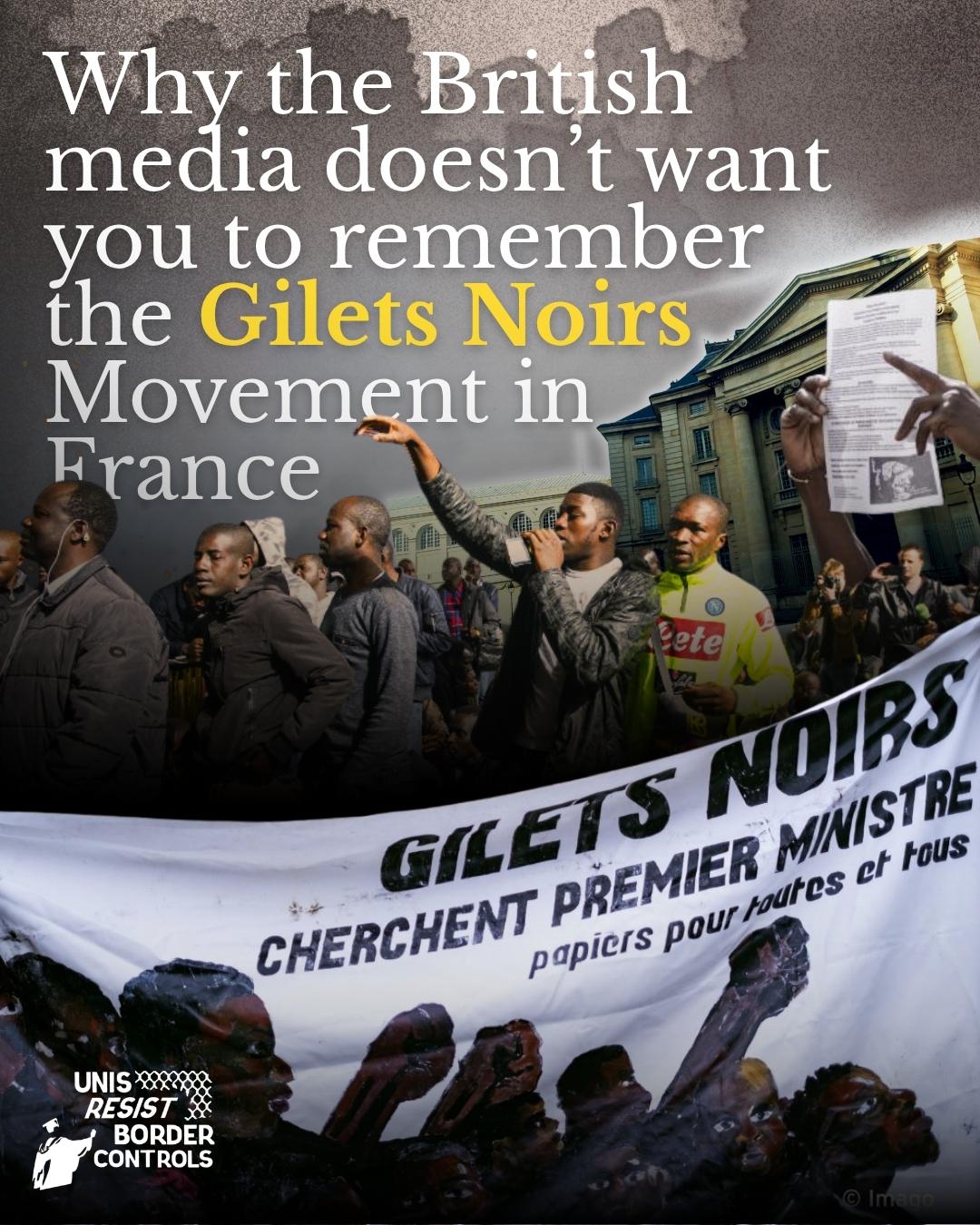
As oppressed racialised youth in France rebel against state violence and austerity, the British media has focused on burning buildings or youth in black masks resisting police terror, to denigrate the protests as nothing more than a riot against law and order. At the same time, when the British media historicises the current protests in France, they refer back to 2018’s Gilet Jaunes, otherwise the Yellow-Vest Movement, against austerity.
For abolionists, conspicuously missing is a mention of the Gilet Noirs, or the Black-Vest Movement, and we explain why this is the case. But first, you need to understand the significance of the Gilet Noirs.
Inspired by the Gilet Jaunes, undocumented migrants in France, calling themselves Gilet Noirs, began to organise in 2019, demanding that their status be regularised after months, sometimes decades, without residency papers, and that they be allowed access to housing and jobs. Fueling the fire of the movement was the passing of the 2018 immigration and asylum bill, which shortens asylum application deadlines from 120 days to 90 days, doubled the time for which undocumented migrants can be detained, and introduced a one-year prison sentence for entering France illegally.
Human Rights Watch added, “Under the guise of providing a more effective asylum system, the bill includes a series of measures that would diminish access to protection.” By shorting the deadline to file an asylum application, Human Rights Watch expressed grave concern, saying, the “most vulnerable asylum seekers, who would be the ones most likely to miss the deadline,” thus becoming undocumented within the French immigration system.
For these reasons, the Gilet Noirs organised to fight the deeply colonial and xeno-racist immigration regime that was forcing many migrants into destitution, subjected to constant police and state violence, with no ability to regularise their status. The Gilet Noirs movement pointedly addressed the neocolonialism at the heart of the French carceral immigration system, stating, “France and its companies grow rich on our backs”. Their politics reminded of the French colonial presence in their respective homelands through businesses like Total and Suez, which steal resources from the Global South while propping up dictators who profit from French business extractivism.
In this way, the Gilet Noirs weren’t only demanding regularised status and residency papers, but calling attention to the colonial politics that dictate their dispossession, both in France and in their respective homelands in the Global South.
To get their message across, the Gilet Noirs organised occupations, the first being a sit-in at the Panthéon, chanting,“Black vests, Black vests. What do we want? Papers! Who for? For everyone!” A few months later, the Gilet Noirs occupied Terminal 2F at Paris’ Charles-de-Gaulle airport, protesting the role of France’s national carrier, Air France, in deportations. The Gilet Noirs said that the airport was, “first and foremost a border. A border without a wall or barbed wire.” The occupation of Charles-de-Gaulle airport by undocumented migrants was also a challenge to the increased deportation policy of the Macron government.
The significance of the Gilet Noirs is unacknowledged by the British media because it was a movement led by undocumented migrants demanding residency while challenging the very colonial structures that oppress their bodies in France and in their home countries. The prospect of an undocumented or pan-migrant movement in Britain rising to dismantle the carceral immigration regime built from the 1960s to the present, and demanding an honest reckoning with colonialism and imperialism, terrifies Britain. Under the Hostile Environment Policy, every citizen, including migrants themselves, is drafted as border cops by exercising border policing whether in the workplace, schools, universities, the NHS, and housing. What terrifies Britain is migrants organizing themselves and dealing blows against the system that keeps them exploited.
But migrant-solidarity NGOs that dot the UK landscape are also not invested in a migrant-led undocumented movement either. In the UK, migrant solidarity is still gatekept by British citizens, whether white or racialised, who lead NGOs that channel migrant rage through milquetoast actions, like appealing to the sympathies of politicians on either side of the Parliamentary aisle, who continue to pass ever more draconian immigration laws designed to placate fascists, who want us dead. The current migrant-solidarity landscape betrays the fact that UK migrants were leading their own movements against colonial policies both here and in their respective homelands. The Asian Youth Movement and the British Black Panthers are testaments to previous racialised, working-class, migrant-led organising that existed in the UK.
While the Gilet Noirs anchored their politics and praxis to anticolonialism, migrant-solidarity NGOs pay lip service to it in name only. Three years into the continued genocide in Gaza and the genocide happening in South Lebanon, along with the war against Iran and now Yemen, instead of joining the national demonstration for Palestine that took place in London on 10 October, they held a protest in Manchester outside of Prime Minister Andy Burnham’s office. Juxtapose the protests and occupations of the Gilet Noirs, intended to be disruptive to the French state, with the UK variety, protesting on a day when the office is closed and Burnham is not in attendance. Moreover, to organise a protest at the same time as the Palestine demonstration commemorating three years of genocide actively divorces migrant struggles from their anticolonial, anti-Zionist, and anti-genocide roots.
Gilet Noirs provides the very inspiration and political direction lacking in the UK’s liberal-bent migrant solidarity, where migrants are seen as always vulnerable, in need of protection, but never with the agency of their voice to make the kinds of connections to forge a struggle to eliminate repression.
Further reading on the Gilet Noirs
Butterly, L. (2019, August 8). Who are the gilets Noirs?. New Internationalist. https://newint.org/features/2019/07/23/who-are-gilets-noirs
Butterly , L. (2020, May 15). The Gilet noirs navigate the lockdown. Verso. https://www.versobooks.com/en-gb/blogs/news/4712-the-gilet-noirs-navigate-the-lockdown
Clerget, T. (2019, July 15). Occupation du panthéon : ” Ils ont voulu terroriser des gens qui ont relevé la tête, et qui n’ont plus peur “. Basta! https://basta.media/Pantheon-gilets-noirs-occupation-sans-papiers-mal-loges-Republique-repression-violences-policieres
Tazzioli, M. (2020). What is left of migrants’ spaces? Political Anthropological Research on International Social Sciences, 1(1), 137–161. https://doi.org/10.1163/25903276-bja10001